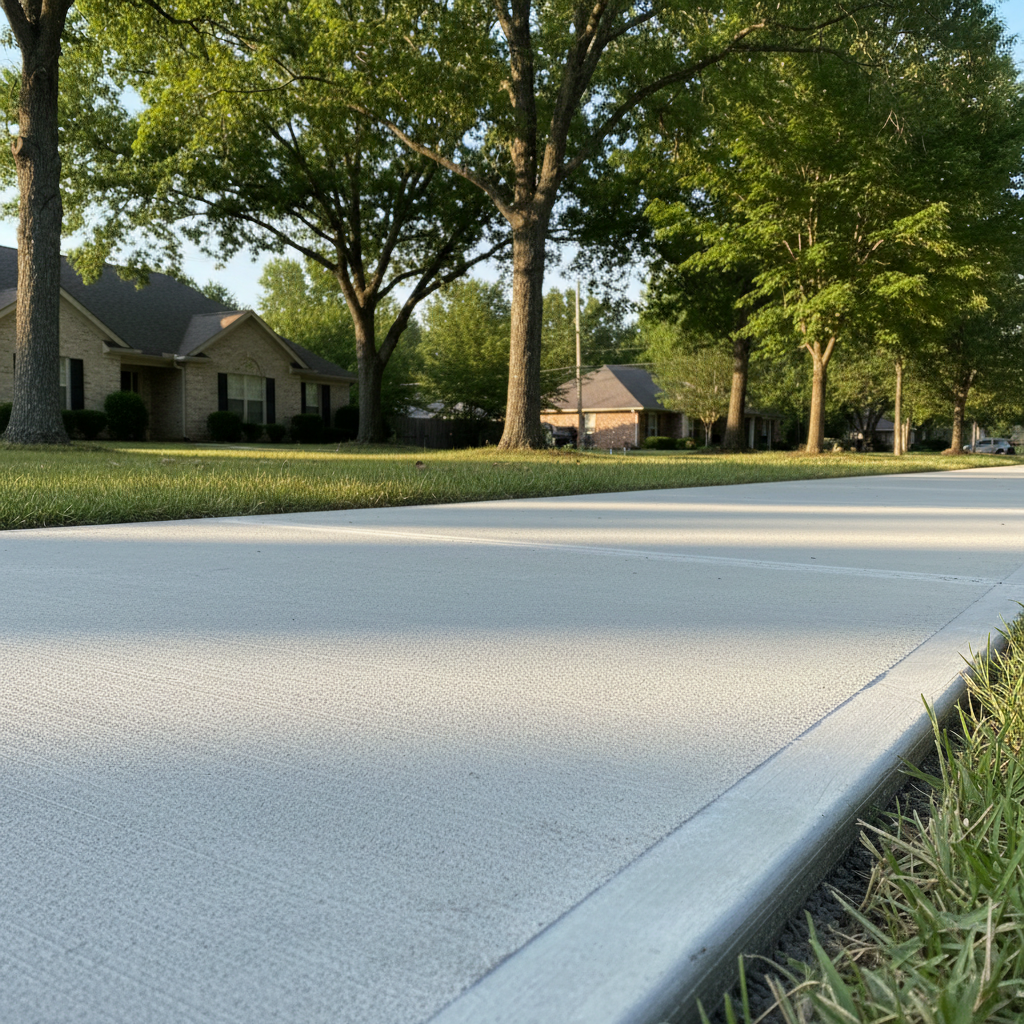
Why do concrete sidewalks crack, and can I prevent it?
Look, cracks in concrete are pretty much a given. It's not really a question of "if," but more like "when" and "how bad." Concrete shrinks as it dries, you see, and that shrinkage creates internal stress. Now, throw in our Mississippi heat and humidity cycles — those scorching, dry spells followed by heavy rains — and you've got a perfect recipe for expansion and contraction. All that movement puts a real squeeze on the concrete.
So, can you prevent *every single* crack? No, absolutely not. But you can definitely keep most of them to a minimum and even guide where they show up. Good planning is super important here. That means making sure the subgrade (that's the dirt underneath) is packed down well and drains correctly. If your sidewalk is sitting on a soft, shifting base, well, it's just going to crack more. We also use control joints – those lines you often see cut into sidewalks. They're not just for looks; they're actually designed to create weak points. This way, the concrete cracks along those lines instead of just randomly breaking across the whole slab. If there aren't enough of them, or if they're not cut deep enough, you'll definitely see more random cracking. A good concrete mix, proper curing, and enough control joints are your best defense, plain and simple.
What's the difference between a minor crack and a serious problem?
This is a question I hear a lot, and it's a good one to ask. Many hairline cracks, especially the ones that follow those control joints, are usually just cosmetic. They're a natural part of concrete's life cycle. If a crack is less than, say, a quarter-inch wide, isn't creating a tripping hazard, and isn't showing signs of significant vertical displacement (meaning one side isn't way higher than the other), it's probably not an emergency. You can often seal these up to keep water out, which helps slow down any further damage.
A serious problem, though, that's a different story. We're talking about cracks that are wide — half an inch or more — or show major vertical displacement (that tripping hazard I mentioned earlier). Or maybe you're seeing spiderweb cracking, which often points to a deeper issue like subgrade failure. If chunks of concrete are spalling off, or if the whole slab is sinking or heaving unevenly, that's a big red flag. These kinds of problems can mean water is undermining the base, tree roots are pushing things up, or maybe it wasn't installed correctly in the first place. Those are the times you absolutely want to get a pro like us at The Branch Concrete out to take a look.
How long should a concrete sidewalk last in Olive Branch?
A concrete sidewalk, when it's installed correctly with a good mix and the right base prep, should easily last 20 to 30 years right here in Olive Branch. I've even seen some go longer, believe it or not. But that's the big thing: