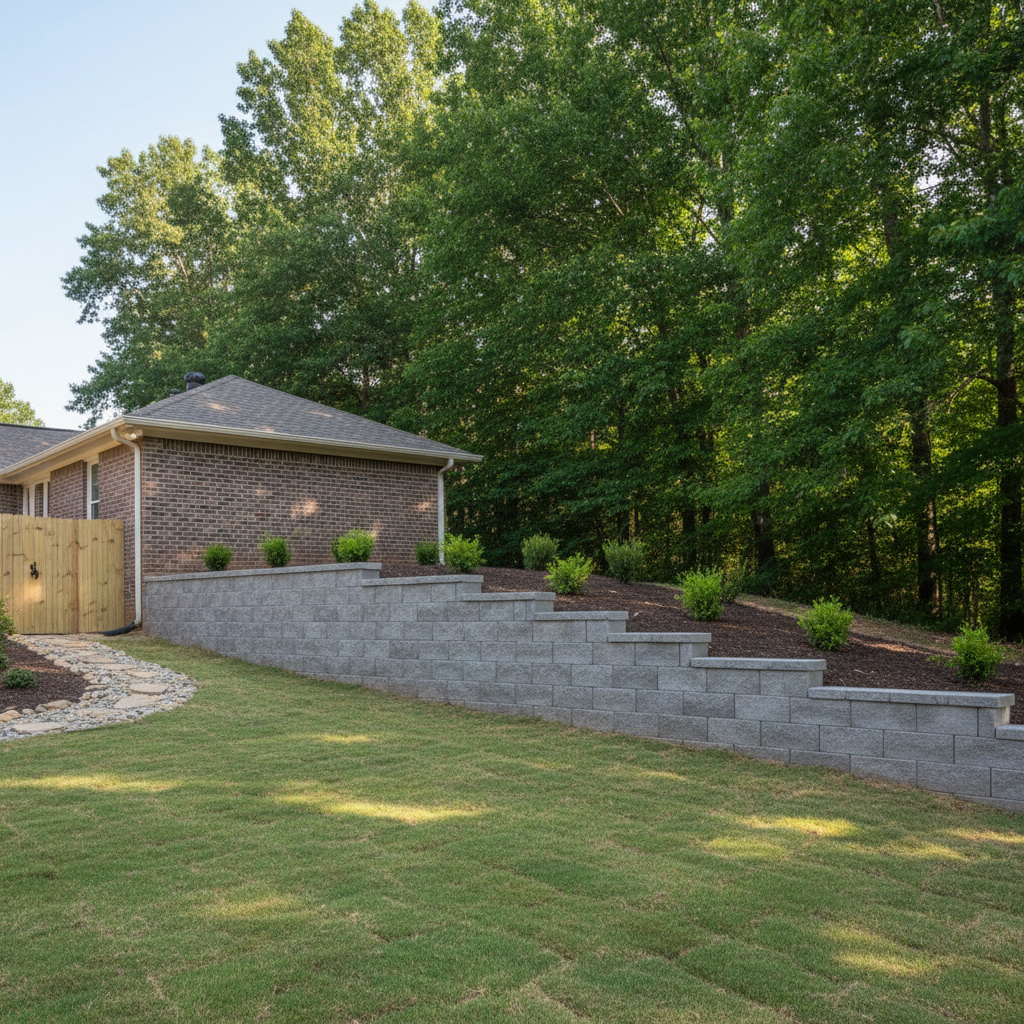
So, you're looking at putting in a concrete retaining wall. Maybe you've got a sloped yard, or you're trying to create some level usable space, or you're just tired of dealing with erosion around your foundation, especially after one of our heavy summer downpours here in Olive Branch. Whatever the reason, you're probably wondering what it's going to set you back. I get that question all the time, so let's talk about it.
What Makes Retaining Walls Cost What They Do?
It's not just a matter of pouring some concrete. A lot goes into pricing a retaining wall, and if someone gives you a super lowball quote without asking these questions, you should probably be a little suspicious. Here's what we look at:
- Wall Height and Length: This is probably the biggest factor. A 2-foot tall wall is a lot less material and labor than a 6-foot tall wall. And obviously, a 50-foot long wall costs more than a 20-foot one. The taller it gets, the more engineering and reinforcement it needs too.
- Wall Type: Are we talking about a simple gravity wall, a cantilevered wall with footings, or something more complex? Concrete block walls are often cheaper upfront than poured concrete, but poured concrete can be stronger and last longer, especially for taller applications. We mostly deal with poured concrete here at The Branch Concrete because it's just a more robust solution for our local soil conditions, which can be pretty clay-heavy and shift a lot.
- Site Accessibility: Can we get our equipment right up to where the wall needs to go, or do we have to haul everything by hand? If we're hauling concrete, rebar, and forms up a steep hill or through a tight gate, that's going to add to the labor cost.
- Excavation Needs: How much dirt needs to be moved? Is it just a shallow trench, or are we digging out a significant slope? What's the soil like? If we hit a bunch of rock, that's going to take more time and specialized equipment.
- Drainage: A good retaining wall isn't just about holding back dirt; it's about managing water. You absolutely need proper drainage behind the wall, usually with gravel and a perforated pipe. If you don't, water builds up, and eventually, that wall is going to fail. That drainage system adds to the material and labor.
- Reinforcement: Taller walls, or walls holding back a lot of pressure, need rebar. Sometimes a lot of it. This isn't an area you want to skimp on.
- Finishing: Do you want a plain concrete finish, or do you want it stamped, stained, or faced with stone veneer? Those decorative touches add to the cost.
Typical Cost Ranges for Concrete Retaining Walls in Olive Branch
Okay, so you want some numbers. I can give you some general ranges based on what I've seen in Olive Branch, but remember, every job is unique. These are for poured concrete walls, which is what we recommend for most permanent solutions.
For a basic, functional poured concrete retaining wall, you're generally looking at $40 to $70 per square foot of wall face. That's the height multiplied by the length. So, a 4-foot high, 30-foot long wall (120 square feet) might run you anywhere from $4,800 to $8,400.
Here's a breakdown by height, just to give you a clearer picture:
- Walls up to 3 feet tall: These are often on the lower end, maybe $40-$55 per square foot. They might not need as much heavy reinforcement or as deep a footing.
- Walls 4 to 6 feet tall: This is where you'll see prices in the $55-$70 per square foot range. These walls definitely need good engineering, substantial footings, and plenty of rebar.
- Walls over 6 feet tall: These get into more complex territory. You're likely looking at $70+ per square foot, and often require specific engineering plans, which adds to the overall project cost.
These prices usually include excavation, forming, rebar, concrete, and basic backfill/drainage. Decorative finishes like stamping or staining will add another $5-$15 per square foot, depending on the complexity.
What Should Be in Your Quote?
When you get a quote from The Branch Concrete or any other contractor, make sure it's detailed. It should clearly spell out:
- The exact dimensions of the wall (height, length, thickness).
- Type of concrete and PSI strength.
- Amount and type of rebar reinforcement.
- Details on the footing size and depth.
- Excavation and backfill plan.
- Drainage system components (gravel, pipe, weep holes).
- Any finishing details (e.g., smooth finish, broom finish).
- Permit acquisition (who's responsible for getting it).
- Warranty information.
If a quote is just a single number on a napkin, walk away. You need to know what you're paying for.
How to Avoid Overpaying
Nobody wants to pay more than they have to, right? Here are my tips:
- Get Multiple Bids: This is a no-brainer. Get at least three quotes. But don't just go with the cheapest. Compare what's included. A slightly higher bid might include better materials or a more robust drainage system that saves you headaches later.
- Be Specific About Your Needs: Know what you want. If you're vague, contractors have to guess, and they'll often pad the estimate to cover unknowns.
- Ask About Value Engineering: Sometimes there are ways to achieve the same goal with a slightly different approach that saves money. A good contractor will be able to suggest alternatives if they exist.
- Check References and Licenses: Make sure the contractor is reputable and insured. You don't want to hire someone who's going to cut corners or disappear halfway through the job.
- Understand the Drainage: I can't stress this enough. A retaining wall without proper drainage is a ticking time bomb. Make sure it's explicitly covered in the quote and that you understand how it will work.
A concrete retaining wall is a big investment, but when it's done right, it can add a lot of value and functionality to your property. Take your time, do your homework, and don't be afraid to ask questions. That's how you ensure you get a solid wall that lasts for decades.